BGD Week 4: The Life of Our Prayers (Lālasā–Yearning)
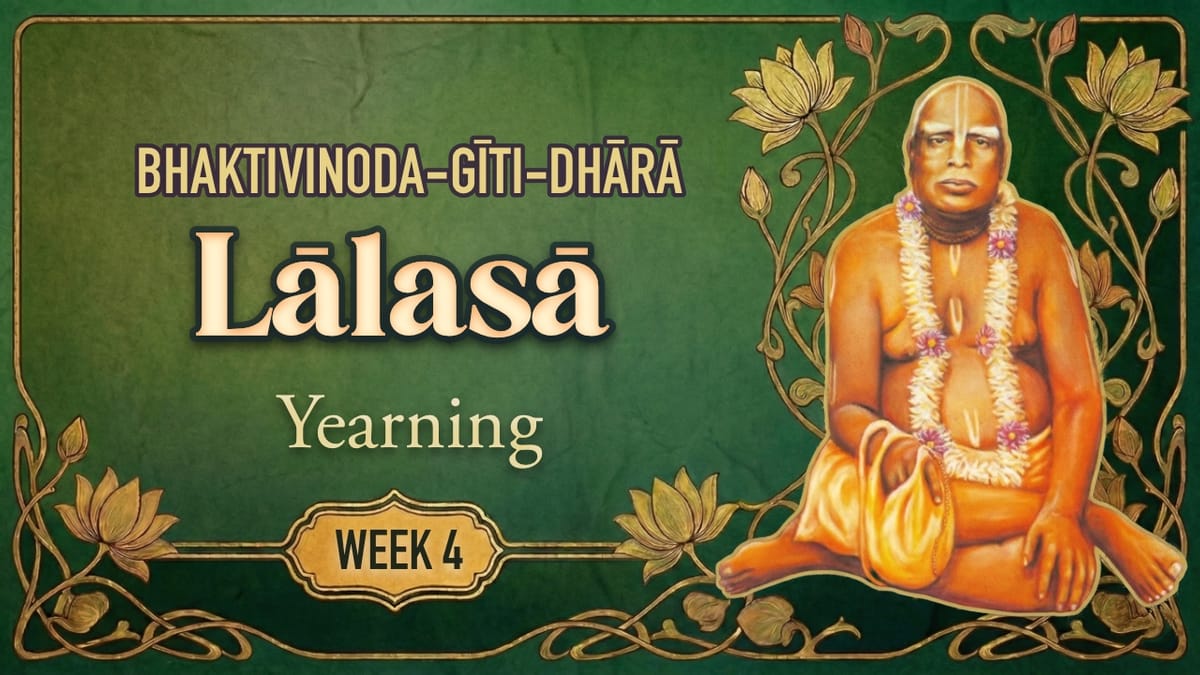
As we enter Week Four of our Bhaktivinoda-gīti-dhārā journey, we arrive at the very heart of devotional practice: Lālasā—spiritual longing.
Up until now, we have journeyed through the foundational landscapes of surrender, the pathway of instruction, and the sweet routine of our daily kīrtanas. But now, Śrīla Bhaktivinoda Ṭhākura, by his ideal example, guides us to glimpse the incessant yearnings of one truly following the path of rāga. He shows us that their life of bhajana is not found only in the external execution of devotional practices, but in the deep, burning internal aspiration to serve.
But just as a fruit must ripen on the branch before it is tasted, our longing must mature through the proper stages.
The Gradual Path of Aspiration
Therefore, before we approach Śrīla Bhaktivinoda Ṭhākura’s songs filled with yearning for specific services to the Divine Couple, we begin with the Bhajana-lālasā section of Śaraṇāgati. We start with “Gurudeva! Kṛpā-bindu Diyā”, in which Śrīla Bhaktivinoda Ṭhākura expresses his utter dependence on the mercy of Śrīla Gurudeva. He prays for the ability to become humble, to tolerate all that comes his way, and to truly offer appropriate honor to all, without desiring recognition for himself.
Before we can aspire for perfection (siddhi), we must aspire for purification through the mercy of guru and the Vaiṣṇavas.
A Note of Caution: Aspiring to Aspire
This week, we will conclude with the Siddhi-lālasā songs—prayers of intense longing for spiritual perfection and eternal service in one’s spiritual body. These songs, like Kabe Gaura-vane, Dekhite Dekhite, and Vṛṣabhānu-sutā, are the crown jewels of our Gauḍīya Rūpānuga aspiration.
However, we must approach them with the utmost caution.
In his introduction to the Gauḍīya Gīti-guccha, Śrīla Bhakti Prajñāna Keśava Gosvāmī Mahārāja gave a stern warning about taking these songs cheaply:
❝ The mahājanas have delineated tiers of kīrtana. There are three categories of devotees... and the mahājanas have composed their songs for devotees of all three classes. For the most part, we are publishing within this Gīti-guccha songs that are only for the neophyte- and intermediate-level sādhakas. We do not wish to publish, for the general public, songs the mahājanas composed for those with the highest level of qualification (uttama-adhikārī). At the same time, such songs have not been completely omitted from this compilation. Readers and kīrtana performers should recite or sing these songs after careful deliberation. ❞
Therefore, in his editions of Śrī Gauḍīya Gīti-guccha, he included only a very few siddhi-lālasā songs.
These songs are not for singing in public or in casual circumstances; they are for our private veneration under the guidance of advanced Vaiṣṇavas. I remember an incident where a brahmacārī began singing Dekhite Dekhite in the temple room of Śrī Keśavajī Gauḍīya Maṭha in Mathurā. Śrīla Gurudeva immediately sent Śrīpāda Mādhava Mahārāja down to stop him. Why? Because to sing these songs in a public setting without the corresponding qualification to enter them can be an offense to the supremely elevated mood they carry.
We will briefly look at them this week not to imitate the bhāva-bhaktas, but to understand what we should aspire to aspire for. We look at the mountain peak from the ground to know the direction of our journey.
Two Types of Longing
To help us understand our position, our ācāryas distinguish between two types of prayers of longing. In his commentary on Bhajana-rahasya (6.9), Śrīla Gurudeva explains that there are:
- Samprārthanātmikā-vijñapti: A prayer by a sādhaka in whom rati (spiritual emotion) has not yet awakened. This prayer is full of longing (lālasā), but it is a prayer for the awakening of that bhāva.
- Lālasāmayī-vijñapti: A prayer by a jāta-rati-bhakta—one in whom bhāva has already appeared. This is a direct yearning for specific service in the spiritual body (siddha-deha).
In his exact words:
"Lālasāmayī-vijñapti is a prayer in which such a devotee prays to attain his desired sevā... Samprārthanātmikā-vijñapti, however, is a prayer by a sādhaka in whom rati has not yet awakened... In such a prayer lālasā or longing is also present but there is an absence of bhāva."
The Price is Greed (Lobha)
How do we move from our current state to that state of perfection? Śrīla Bhakti Pramoda Purī Gosvāmī Mahārāja, in Chapter 14 of his book The Art of Sādhana, explains that the only price is lobha (intense greed). He cites the verse "kṛṣṇa-bhakti-rasa-bhāvitā matiḥ" from Padyāvalī (14):
"Since Kṛṣṇa consciousness soaked with devotion cannot be achieved even after the practice of hundreds of thousands of pious acts, one must pay the only price by which it can be bought: intense greed (laulya, or lobha) to have it. Should one come across this greed, one should grab it eagerly."
He explains that the word laulya (greed) in this verse is a synonym for lālasā. While we may faithfully follow the path of vidhi-mārga (regulative principles), real entrance into the mood of Vraja requires this intense spiritual greed.
"Devotional service on the path of rāgānugā-bhakti is based on faith that has intense desire (lobha). Such greed or intense desire is extremely rare; Śrīla Rūpa Gosvāmī explains that when a devotee hears the divinely inspired scriptures like Śrīmad-Bhāgavatam and Padma Purāṇa from the lips of a realized guru, or other descriptions of the sweet pastimes of the Lord with His Vṛndāvana devotees in the five relations, he becomes affected by the delightful moods expressed by these eternally perfected associates of the Lord."
When that greed awakens, one’s practice becomes spontaneous. However, to safely attain and sustain such a rare treasure, Śrīla Bhakti Pramoda Purī Gosvāmī Mahārāja reminds us that we must rely entirely on the mercy of Śrī Gurudeva, who grants us the discrimination to recognize true devotion:
"Without the mercy of the spiritual master one cannot receive the mercy of the Vaiṣṇavas. And without the mercy of both the spiritual master and the Vaiṣṇavas, there is no hope of receiving the Supreme Lord’s mercy. The spiritual master gives us the power to recognize the real devotees and separate them from those who simply pretend to be devotees." (The Art of Sādhana, Chapter 4)
Our Week Ahead
This week, we will go through the prayers of longing to Śrī Guru and Vaiṣṇavas, then longing to receive the mercy of Gaura-Nityānanda in Navadvīpa, and then very carefully and respectfully offer our distant veneration to the mood of Siddhi-lālasā, to understand the beautiful destination that awaits us if we remain true to this path.
For as Śrīla Gurudeva said, quoting from Prema-bhakti-candrikā:
"The desire one has during the stage of sādhana will determine his siddha-deha. The difference between the stage of sādhana and the stage of siddhi (perfection) is only 'pakva-apakva matra se vicāra' (stages of ripe and unripe)... Sādhana is the unripe stage and siddhi is the ripe stage." (full article here)
May the aspiration of our sādhana remain ever before us, as we continually cultivate the seed of the vine of devotion until it ripens into the sweet fruit of service.
Your Selection for Week 4
Below is the link to the selection form for this week. As before, I invite you to read through the list and select up to four songs that call you.
Join the Daily Program
We are continuing our daily online sessions where we discuss these songs and their practical application.
- Dates: Jan 1 – Feb 14, 2026
- Time: 7:00 – 8:00 AM IST (Check your local time here)
- Where: Zoom and YouTube
If you missed any of the previous sessions, you can catch up on my YouTube channel. For more details on ways to join our program and links to our WhatsApp groups, click here.
I look forward to taking this next step in our journey through the flow (dhārā) of Śrīla Bhaktivinoda Ṭhākura's songs.


Comments ()