BGD Week 5: The Means and the Destination—Śrī Nāma
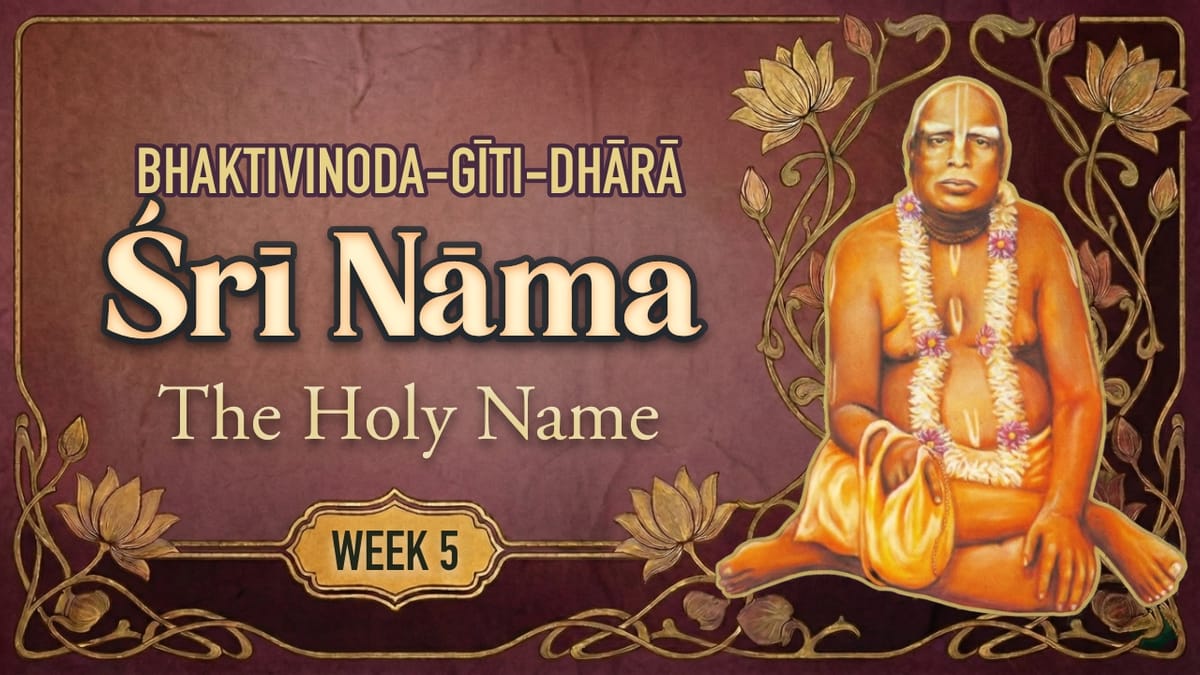
Welcome to the fifth and final week of our Bhaktivinoda-gīti-dhārā program. Over the last month, our journey through the songs of Śrīla Bhaktivinoda Ṭhākura has taken us through Śaraṇāgati (surrender), Upadeśa (instruction), the daily kīrtanas, and Lālasā (yearning). Now, we arrive at the summit: Śrī Nāma.
Throughout all our scriptures, and especially in the books of our Gosvāmīs, the glories of the process of chanting harināma are emphasized above all other practices (tāra madhye sarva-śreṣṭha nāma-saṅkīrtana). All Gauḍīya Vaiṣṇavas clearly understand that chanting the mahā-mantra is our everything, for it is non-different from Kṛṣṇa Himself but in a form that is accessible. It is the primary instruction of Śrīman Mahāprabhu and the central jewel of His Śikṣāṣṭaka (param vijayate śrī kṛṣṇa-saṅkīrtanam). Indeed, as we hear directly from Mahāprabhu in Śrī Caitanya-caritāmṛta (Madhya 15.111, 16.72–75) and from His associate Śrīla Narahari Sarakāra in Kṛṣṇa-bhajanāmṛta, one’s true standing as a kaniṣṭha, madhyama, or uttama Vaiṣṇava is determined solely by the quality, or power, of one’s chanting of kṛṣṇa-nāma.
The Challenge: The Mind vs. The Mantra
But how do we actually chant? If we are left with just the mahā-mantra and no guide, our chanting will end up falling under the direction of our flickering mind. Without proper sambandha and an inclination to serve under proper guidance, the chanting becomes mechanical and the name will not come in contact with the tongue or other senses.
As Śrīla Rūpa Gosvāmī explains in Bhakti-rasāmṛta-sindhu (1.2.234):
ataḥ śrī-kṛṣṇa-nāmādi / na bhaved grāhyam indriyaiḥ
sevonmukhe hi jihvādau / svayam eva sphuraty adaḥ
“Therefore, the name and other aspects of Śrī Kṛṣṇa [such as His form, qualities, and pastimes] cannot be perceived by the senses. Indeed, when the tongue and other senses are inclined to service, then that name and so forth manifest on their own.”
Śrīla Jagannātha dāsa Bābājī Mahārāja warns us against the trap of mechanical chanting devoid of this service attitude:
Do not develop laziness on the pretext of performing solitary bhajana. It is more beneficial to cultivate fields and water plants for the service of the Vaiṣṇavas than to inattentively pull beads hundreds of thousands of times. The result of serving the Vaiṣṇavas is genuine taste for the holy name.
(Gauḍīya, Year 17, pp. 504-5)
Similarly, Śrīla Gaurakiśora dāsa Bābājī Mahārāja advises us to chant with intensity rather than artificial meditation:
Sit near me and chant the names of Śrī Hari in a loud voice. By artificially engaging in the remembrance of pastimes, the ghost of anarthas and the evil spirit of māyā shall seize your neck with greater force.
(Gauḍīya, Vol. 14, p. 218)
Both quotes published at the end of Paramgurudeva's article in Rays of The Harmonist No. 15 Kārtika 2005
If we ignore this guidance, there is little value in simply “pulling rope.” We will not be able to have genuine contact with nāma, effectively blocking the holy name from touching us due to our offenses.
The Guide: Śrīla Bhaktivinoda Ṭhākura
This is where Śrīla Bhaktivinoda Ṭhākura’s guidance becomes indispensable. He has gifted us many books and articles containing hundreds (if not thousands) of pages of invaluable instructions on how to dive deep into the process of chanting.
He did not treat the name as an abstract concept; he established a tangible “economy” around it, famously singing:
nadīyā-godrume nityānanda mahājana
pātiyāche nāma-haṭṭa jīvera kāraṇa
“On the island of Godruma in the land of Nadīyā, the magnanimous personality Śrī Nityānanda Prabhu has opened a marketplace of the holy name for the benefit of all living beings.”
In his vision of the Nāma-haṭṭa (Marketplace of the Holy Name), there are specific roles and transactions designed to distribute and purchase the holy name from Nityānanda Prabhu’s marketplace. You can read fascinating details about this spiritual economy in his book Śrī Godruma-kalpatāvī.
To inaugurate this distribution, Bhaktivinoda Ṭhākura published the six Vaiṣṇava-siddhānta-mālā booklets, which contain many of these Nāma-haṭṭa songs we sang in Week Three as well as the Śikṣāṣṭaka songs, Nāmāṣṭaka songs, and nāma-kīrtanas we will be going through this week.
I cannot think of anyone who has advocated the glories, necessity, and process of chanting nāma with as much depth—and with the process so clearly identified—as Śrīla Bhaktivinoda Ṭhākura. When our practice of chanting feels extremely weak, I've found his article Sādhana and these songs to serve as the most powerful boosts for getting serious about the process of nāma-japa.
The Holy Name in the Holy Abode
As the song above declares, this marketplace is established specifically in Śrī Godruma. But why is the connection to the dhāma so vital? Śrīla Bhaktisiddhānta Sarasvatī Ṭhākura explains:
We failed to realize how exalted the dhāma was and thus had no predilection for dhāma-sevā... But a certain holy saint engaged us in dhāma-sevā, saying that it would bring the highest welfare... Śrī vaikuṇṭha-nāma alone has come down to this earth, and it is in śrī dhāma that śrī nāma has been deposited. Pretentious nāma-sevā performed by one who disconnects oneself from śrī dhāma, does not give the real end: kṛṣṇa-kāma-sevā.
(From The Gaudiya Vol 5, No 7)
This deep connection between the dhāma and the nāma is found throughout his songs. For example, he declares that “to reside in the transcendental dhāma and to relish the name of Gaurahari are the sādhus’ sole aspiration” (Navadvīpa-dhāma-māhātmya 9.7), and he prays, “I long to pass my days and nights uttering Your name within Your holy abode.” (Prabhu He! Tuwā Pade E Minati Mora 4).
He paints his vision of perfection on the banks of the Gaṅgā: “Sitting in a solitary place within a transcendental forest on the bank of the Jāhnavī River, I shall continuously drink the nectar of Śrī Kṛṣṇa’s name.” (Kabe Ha’be Heno Daśā Mora 3).
On the location of Nityānanda Prabhu's marketplace, he reminds us of śrī gurudeva's order: “O Gurudeva, you have ordered me to dwell in this forest of Godruma which is [non-different from] Vraja and to chant the holy names of Śrī Hari. But when, O Master, will you mercifully bestow upon this servant the qualification to fulfill your order?” (Gurudeva, Baḓo Kṛpā Kari’ 1–2).
Thus, his instruction to us is clear: “With the ambrosial rasa of śrī harināma intoxicating your mind, perform bhajana of the moon of Godruma’s forest bowers.” (Godruma-candra-bhajanopadeśa 3).
The Conclusion is Nāma
Originally, I considered placing nāma in the fourth week and ending with lālasā (spiritual longing). But upon reflection, I realized that Śrīla Bhaktivinoda Ṭhākura consistently places nāma as the ultimate conclusion. For example, in Śaraṇāgati, the song Kṛṣṇa-nāma Dhare Kato Bala serves as the final crowning jewel, appearing even after the three Siddhi-lālasā songs. Similarly, in his Daśa-mūla-tattva verses and the corresponding chapters of Jaiva-dharma, after rigorously explaining sambandha, abhideya, and prayojana, he concludes with three chapters describing the glories of śrī nāma. Even his final major work, Śrī Bhajana-rahasya, which follows Harināma-cintāmaṇi, is dedicated entirely to the internal depth of nāma-bhajana.
In Bhajana-rahasya, Śrīla Bhaktivinoda Ṭhākura reveals the deep, ever-unfolding process of chanting the mahā-mantra. He shows how each pair of names in the mahā-mantra is intricately tied to the eight verses of the Śikṣāṣṭaka. He explains that for the sādhaka, these verses guide us through the progressive stages of development (from śraddhā to bhāva). And for one in whom bhāva has awakened, these same names and verses correspond to Śrī Śrī Rādhā-Govinda’s aṣṭa-kālīya-līlā—Their eternal pastimes as they unfold through the eight periods of the day.
In Bhajana-rahasya (1.10), he uses the word krama (sequence) six times, highlighting that the Śikṣāṣṭaka isn't just a collection of nice prayers; it is a step-by-step methodology for gaining perfection in chanting.
Week 5: The Songs
In this fifth and last week of our Bhaktivinoda-gīti-dhārā program, we will focus on the kīrtanas Śrīla Bhaktivinoda Ṭhākura wrote specifically to glorify the name and to beg for the mercy to chant purely.
- Śrī Nāmāṣṭaka: These eight songs are Śrīla Bhaktivinoda Ṭhākura’s expanded Bengali translations that enable one to enter deep into Śrīla Rūpa Gosvāmī’s Sanskrit Nāmāṣṭaka.
- Śrī Śikṣāṣṭaka: Based on the eight verses composed by Śrī Caitanya Mahāprabhu, these songs guide the sādhaka through the stages of chanting—from the initial cleansing of the heart to the intense separation felt by the perfected devotee.
- Śrī Nāma-māhātmya: These songs focus specifically on the extraordinary power of the Name to remove offenses and bestow prema, acting as a touchstone that reveals our spiritual identity.
- Śrīman Mahāprabhur Śata-nāma: A collection of 100 names of Śrīman Mahāprabhu that Śrī Nityānanda sings as He dances throughout the towns of Nadīyā.
- Śrī Kṛṣṇer Viṁśottara-śata-nāma: A collection of 120 names of Śrī Kṛṣṇa that Gaurāṅga Mahāprabhu sings as He wanders from village to village.
- Nāma-kīrtanas from Kalyāṇa-kalpataru: These are the famous songs Kali-kukkura-kadana and Vibhāvarī Śeṣa, which present many names of Mahāprabhu and Kṛṣṇa that reveal Their pastimes and relationships with Their intimate associates.
A Second Chance for Previous Songs
In the selection form this week, you will also find other songs related to nāma that we have covered in previous weeks, such as the Nagara-kīrtana songs and Gurudeva kīrtanas. If you missed out on selecting them earlier, you have a second chance to select them now.
Your Selection for Week 5
Below is the link to the selection form for this final week. As before, I invite you to read through the list and select up to four songs that call you.
Join the Daily Program
We are continuing our daily online sessions where we discuss these songs and their practical application.
- Dates: Jan 1 – Feb 14, 2026
- Time: 7:00 – 8:00 AM IST (Check your local time here)
- Where: Zoom and YouTube
If you missed any of the previous sessions, you can catch up on my YouTube channel. For more details on ways to join our program and links to our WhatsApp groups, click here.
I look forward to taking this next step in our journey through the flow (dhārā) of Śrīla Bhaktivinoda Ṭhākura's songs.

Comments ()