Tuesday: Dainya & Ātma-nivedana – From Humility to Offering Myself
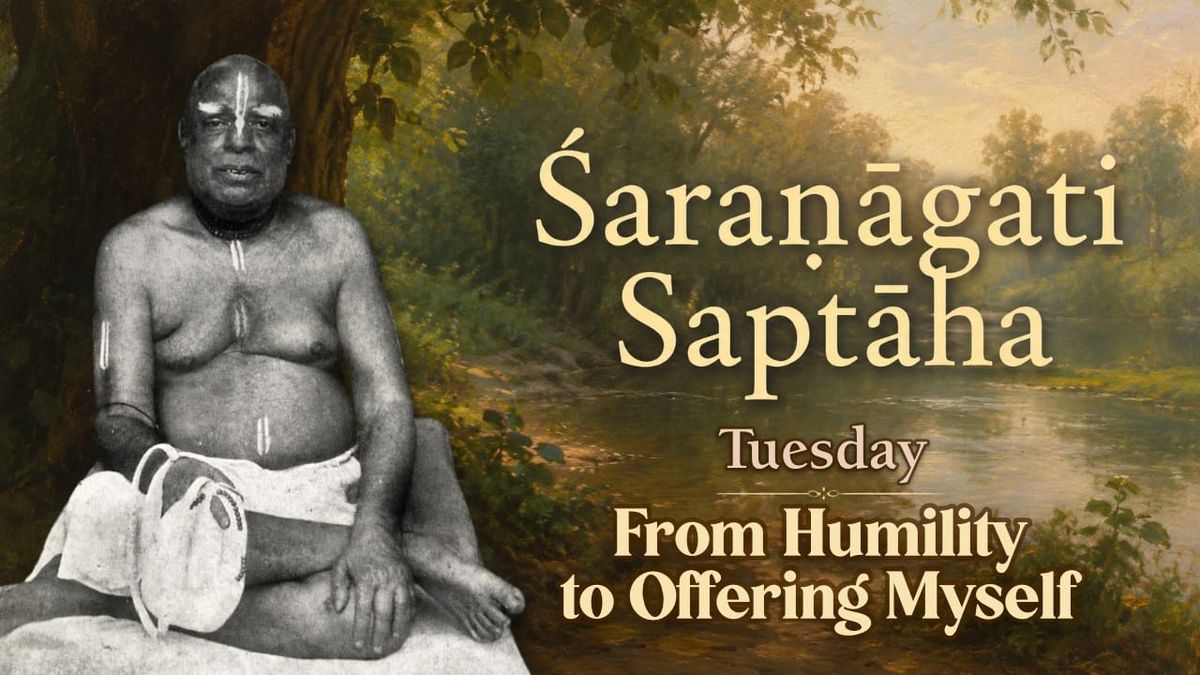
Table of Contents
- (Prabhu He!) Tuwā Pade E Minati Mora
- Prabhu He! Emana Durmati
- Nā Karalũ Karama
- (Prāṇeśvara!) Kahabũ Ki Saram Ki Bāt
- Mānasa, Deha, Geha
(Prabhu He!) Tuwā Pade E Minati Mora
(prabhu he!) tuwā pade e minati mora
tuwā pada-pallava, tyajato maru-mana,
viṣama-viṣaye bhelo bhora (1)
Phrase Breakdown: ① (prabhu he!) tuwā pade e minati mora—O Master! This is my supplication at Your feet; ② tuwā pada-pallava—the tender leaves of Your feet, tyajato maru-mana—my desert-like heart having rejected; ③ viṣama-viṣaye bhelo bhora—has become consumed by excessive indulgence in worldly pleasures.
Word-for-Word: ① (prabhu he!)—O Master! • tuwā—Your • pade—at the feet • e—this • minati (anunaya)—supplication • mora—my ② tuwā—Your • pada-pallava—tender leaves of the feet • tyajato (tyāga kariyā)—having rejected • maru-mana (maru-bhūmira nyāya mana)—desert-like mind ③ viṣama (ghora)—terrible/excessive • viṣaye—in worldly pleasures • bhelo (ha-ila)—became • bhora (magna)—consumed/immersed.
O Master! This is my supplication at Your feet. My desert-like heart rejected the tender leaves of Your feet, having been consumed by excessive indulgence in worldly pleasures.
uṭhawite tākata, punaḥ nāhi mila·i,
anudina karahũ hutāśa
dīna-jana-nātha, tuhũ kahāyasi,
tohāri caraṇa mama āśa (2)
Phrase Breakdown: ① uṭhawite tākata—the strength to rise, punaḥ nāhi mila·i—I do not find again; ② anudina karahũ hutāśa—each passing day brings only despair; ③ dīna-jana-nātha—the refuge of the destitute, tuhũ kahāyasi—You are said to be; ④ tohāri caraṇa mama āśa—all my hopes rest solely at Your feet.
Word-for-Word: ① uṭhawite (uṭhite)—to rise • tākata (śakti, bala, sāmarthya, tāgad)—strength • punaḥ—again • nāhi mila·i—I do not find ② anudina—each passing day • karahũ (karitechhi)—I do/feel • hutāśa—despair ③ dīna-jana—of the destitute • nātha—the Lord/refuge • tuhũ—You • kahāyasi (kathita hao, balāiyā thāka)—are said to be ④ tohāri (tomāra-i)—Your • caraṇa—feet • mama—my • āśa—hope.
I do not find the strength to rise again. Each passing day brings only despair. It is said that You are the refuge of the destitute; thus all my hopes rest solely at Your feet.
aichana dīna-jana, kãhi nāhi mila·i,
tuhũ more karo parasāda
tuwā jana-saṅge, tuwā kathā-raṅge,
chāḓahũ sakala paramāda (3)
Phrase Breakdown: ① aichana dīna-jana—such a destitute person, kãhi nāhi mila·i—nowhere will You encounter; ② tuhũ more karo parasāda—please show me Your grace; ③ tuwā jana-saṅge—in the company of Your devotees, tuwā kathā-raṅge—immersed in the joy of hari-kathā; ④ chāḓahũ sakala paramāda—I may relinquish all my faults.
Word-for-Word: ① aichana (airūpa)—such • dīna-jana—destitute person • kãhi (kothāo, kona-sthāne)—nowhere • nāhi mila·i—will not be found ② tuhũ—You • more—to me • karo—do • parasāda (prasāda, anugraha, kṛpā)—grace ③ tuwā—Your • jana-saṅge—in the association of devotees • tuwā—Your • kathā-raṅge—in the joy of discussing ④ chāḓahũ—I may relinquish • sakala—all • paramāda—faults/mistakes.
Nowhere will You encounter anyone as pitiful as me. Please show me Your grace. In the company of Your devotees, immersed in the joy of hari-kathā, I may relinquish my faults.
tuwā dhāma-māhe, tuwā nāma gāoto,
gõwāobũ divā-niśi āśa
tuwā pada-chāyā, parama suśītala,
māge bhakativinoda dāsa (4)
Phrase Breakdown: ① tuwā dhāma-māhe—within Your holy abode, tuwā nāma gāoto—singing Your name; ② gõwāobũ divā-niśi āśa—longing to pass my days and nights; ③ tuwā pada-chāyā—the shade of Your feet, parama suśītala—supremely soothing; ④ māge bhakativinoda dāsa—Bhaktivinoda dāsa begs.
Word-for-Word: ① tuwā—Your • dhāma—abode • māhe (mājhe)—within • tuwā—Your • nāma—name • gāoto (gāhiyā)—singing ② gõwāobũ (yāpana kariba)—I will pass • divā-niśi—day and night • āśa—longing ③ tuwā—Your • pada-chāyā—shade of the feet • parama—supremely • suśītala—soothing ④ māge—begs • bhakativinoda dāsa—Bhaktivinoda dāsa.
Longing to pass my days and nights uttering Your name within Your holy abode, Bhaktivinoda begs the supremely soothing shade of Your feet.
Prabhu He! Emana Durmati
(prabhu he!)
emana durmati, saṁsāra bhitare,
paḓiyā āchinu āmi
tava nija-jana, kono mahājane,
pāṭhāiyā dile tumi (1)
Phrase Breakdown: ① (prabhu he!) emana durmati—O Lord! I am so unfortunate, saṁsāra bhitare—into this material world; ② paḓiyā āchinu āmi—I had fallen; ③ tava nija-jana—one of Your own associates, kono mahājane—an exalted soul; ④ pāṭhāiyā dile tumi—You sent.
Word-for-Word: ① (prabhu he!)—O Lord! • emana—so • durmati—unfortunate • saṁsāra bhitare—into the material world ② paḓiyā āchinu—had fallen • āmi—I ③ tava—Your • nija-jana (pārṣada)—own associate • kono—some • mahājane (āchārya śrī-gurudeva)—exalted soul ④ pāṭhāiyā dile—having sent, gave • tumi—You.
O Lord! I am so unfortunate to have fallen into this material world, but You have sent an exalted soul, one of Your own associates [to save me].
dayā kari’ more, patita dekhiyā,
kahilo āmāre giyā
“ohe dīna-jana, śuno bhālo kathā,
ullasita habe hiyā (2)
Phrase Breakdown: ① dayā kari’ more—having shown compassion to me, patita dekhiyā—having seen me fallen; ② kahilo āmāre giyā—having approached, he told me; ③ “ohe dīna-jana—“O humbled soul, śuno bhālo kathā—listen to this good advice; ④ ullasita habe hiyā—your heart will become joyful.
Word-for-Word: ① dayā kari’—having shown compassion • more—to me • patita—fallen • dekhiyā—having seen ② kahilo—he told • āmāre—me • giyā—having approached ③ “ohe—O • dīna-jana—humbled soul • śuno—listen • bhālo—good • kathā—advice/words ④ ullasita—joyful • habe—will become • hiyā—heart.
Being compassionate upon seeing me in such a fallen condition, he said, “O humbled soul, listen to this good advice by which your heart will become joyful.
“tomāre tārite, śrī kṛṣṇa caitanya,
navadvīpe avatāra
tomā’ heno kato, dīna hīna jane,
karilena bhava-pāra (3)
Phrase Breakdown: ① “tomāre tārite—“to deliver you, śrī kṛṣṇa caitanya—Śrī Kṛṣṇa Caitanya; ② navadvīpe avatāra—has descended in Navadvīpa; ③ tomā’ heno kato—so many like you, dīna hīna jane—poor and lowly souls; ④ karilena bhava-pāra—He has led across material existence.
Word-for-Word: ① “tomāre—you • tārite—to deliver • śrī kṛṣṇa caitanya—Śrī Kṛṣṇa Caitanya ② navadvīpe—in Navadvīpa • avatāra—descent/incarnation ③ tomā’ heno—like you • kato—so many • dīna hīna—poor and lowly • jane—souls ④ karilena—He made • bhava-pāra—cross over material existence.
“To deliver you, Śrī Kṛṣṇa Caitanya has descended to the land of Navadvīpa. He has led so many poor and lowly souls like you across the ocean of material existence.
“vedera pratijñā, rākhibāra tare,
rukma-varṇa vipra-suta
mahāprabhu nāme, nadīyā mātāya,
saṅge bhāi avadhūta (4)
Phrase Breakdown: ① “vedera pratijñā—“the promise of the Vedas, rākhibāra tare—in order to fulfill; ② rukma-varṇa vipra-suta—with a golden complexion as the son of a brāhmaṇa; ③ mahāprabhu nāme—known by the name Mahāprabhu, nadīyā mātāya—He maddens Navadvīpa; ④ saṅge bhāi avadhūta—accompanied by His brother, the avadhūta.
Word-for-Word: ① “vedera—of the Vedas • pratijñā—promise • rākhibāra tare—in order to keep ② rukma-varṇa (gaura-varṇa, puraṭa sundara dyuti)—golden complexion • vipra-suta—son of a brāhmaṇa ③ mahāprabhu nāme—by the name Mahāprabhu • nadīyā mātāya—maddens Nadīyā ④ saṅge—along with • bhāi—brother • avadhūta—the avadhūta.
“In order to fulfill the promise of the Vedas, He has appeared with a golden complexion as the son of a brāhmaṇa. Known by the name ‘Mahāprabhu’, He and His brother, the avadhūta Nityānanda, have caused all of Nadīyā to become maddened in divine ecstasy.
“nanda-suta ĵini, caitanya gõsā̃ī,
nija-nāma kari’ dāna
tārilo jagat, tumi-o ĵāiyā,
laho nija-paritrāṇa” (5)
Phrase Breakdown: ① “nanda-suta ĵini—“He who is the son of Nanda, caitanya gõsā̃ī—is Lord Caitanya; ② nija-nāma kari’ dāna—having distributed His own holy name; ③ tārilo jagat—He has saved the world, tumi-o ĵāiyā—having gone there yourself too; ④ laho nija-paritrāṇa”—accept your own deliverance.
Word-for-Word: ① “nanda-suta—son of Nanda • ĵini—who • caitanya gõsā̃ī—Lord Caitanya ② nija-nāma—own name • kari’ dāna—having distributed ③ tārilo—He saved • jagat—the world • tumi-o—you also • ĵāiyā—having gone ④ laho—take • nija-paritrāṇa”—own deliverance.
“Śrī Caitanya, who is directly the son of Nanda, has saved the world by distributing His own holy name. You go, also, and receive your deliverance.”
se-kathā śuniyā, āsiyāchi, nātha!
tomāra caraṇa-tale
bhakativinoda, kā̃diyā kā̃diyā,
āpana kāhinī bole (6)
Phrase Breakdown: ① se-kathā śuniyā—having heard those words, āsiyāchi, nātha!—I have come, O Lord! ② tomāra caraṇa-tale—at the base of Your lotus feet; ③ bhakativinoda—Bhaktivinoda, kā̃diyā kā̃diyā—weeping continually; ④ āpana kāhinī bole—tells his own story.
Word-for-Word: ① se-kathā—those words • śuniyā—having heard • āsiyāchi—have come • nātha!—O Lord! ② tomāra—Your • caraṇa-tale—at the feet ③ bhakativinoda—Bhaktivinoda • kā̃diyā kā̃diyā—weeping and weeping ④ āpana—own • kāhinī (kathā)—story • bole—tells.
O Lord, hearing these words, Bhaktivinoda has come to Your lotus feet. Weeping, he tells the story of his life.
Nā Karalũ Karama
nā karalũ karama, geyāna nāhi bhelo,
nā sevilũ caraṇa tohāra
jaḓa-sukhe mātiyā, āpanaku vañca·i,
pekhahũ caudiśa āndhiyāra (1)
Phrase Breakdown: ① nā karalũ karama—I did not perform good deeds, geyāna nāhi bhelo—no knowledge developed; ② nā sevilũ caraṇa tohāra—I did not serve Your feet; ③ jaḓa-sukhe mātiyā—having become maddened by material enjoyment, āpanaku vañca·i—having cheated myself; ④ pekhahũ caudiśa āndhiyāra—I see darkness in all four directions.
Word-for-Word: ① nā—not • karalũ (karilāma)—I did • karama—deeds • geyāna (jñāna)—knowledge • nāhi bhelo—did not develop ② nā—not • sevilũ (sevilāma)—I served • caraṇa—feet • tohāra (tomāra)—Your ③ jaḓa-sukhe—by material enjoyment • mātiyā—having been maddened • āpanaku (āpanake)—myself • vañca·i (vañchanā kariyā)—having cheated ④ pekhahũ (dekhitechhi)—I see • caudiśa (chāridik)—in four directions • āndhiyāra (andhakāra)—darkness.
I have not performed good deeds, nor have I acquired any knowledge or served Your feet. Maddened by material enjoyment, I have cheated myself, thus I see only darkness in every direction.
tuhũ nātha! karuṇā-nidāna
tuwā pada-paṅkaje, ātma-samarpilũ,
more kṛpā karobi vidhāna (2)
Phrase Breakdown: ① tuhũ nātha! karuṇā-nidāna—You, O Lord, are the ultimate source of mercy; ② tuwā pada-paṅkaje—at Your lotus feet, ātma-samarpilũ—I surrendered myself; ③ more kṛpā karobi vidhāna—please dispense Your grace upon me.
Word-for-Word: ① tuhũ—You • nātha!—O Lord! • karuṇā—of mercy • nidāna (ākara)—source ② tuwā—Your • pada-paṅkaje—at lotus feet • ātma—myself • samarpilũ (samarpaṇa karilāma)—surrendered ③ more—to me • kṛpā—grace • karobi—please do • vidhāna (vyavasthā)—dispensation/arrangement.
You, O Lord, are the ultimate source of mercy. I have submitted myself at Your lotus feet. Please dispense Your grace upon me.
pratijñā tohāra ai, ĵo hi śaraṇāgata,
nāhi so jānobo paramāda
so hāma duṣkṛti, gati nā hera·i āno,
āb māgõ tuwā parasāda (3)
Phrase Breakdown: ① pratijñā tohāra ai—this is Your promise, ĵo hi śaraṇāgata—one who is surrendered; ② nāhi so jānobo paramāda—he will not know any misfortune; ③ so hāma duṣkṛti—thus I who am most reprehensible, gati nā hera·i āno—do not perceive any other resort; ④ āb māgõ tuwā parasāda—now I am begging for Your sanctifying grace.
Word-for-Word: ① pratijñā—promise • tohāra—Your • ai—this • ĵo hi—one who • śaraṇāgata—is surrendered ② nāhi—not • so (sei)—he • jānobo—will know • paramāda—misfortune ③ so—thus • hāma—I • duṣkṛti—reprehensible/sinner • gati—resort • nā hera·i—do not perceive • āno (anya)—other ④ āb—now • māgõ (māgitechhi)—am begging • tuwā—Your • parasāda—grace.
Your promise is that one who has surrendered unto You will never know any misfortune. Thus I, who am most reprehensible, perceive no other resort. Now I am begging for Your sanctifying grace.
āno manoratha, niḥśeṣa choḓata,
kab hāma ha·ubũ tohārā
nitya sevya tuhũ, nitya-sevaka muĩ,
bhakativinoda bhāva sārā (4)
Phrase Breakdown: ① āno manoratha—other desires, niḥśeṣa choḓata—having abandoned completely; ② kab hāma ha·ubũ tohārā—when will I become Yours? ③ nitya sevya tuhũ—You are eternally the object of service, nitya-sevaka muĩ—I am Your eternal servant; ④ bhakativinoda bhāva sārā—this is the essence of Bhaktivinoda’s sentiments.
Word-for-Word: ① āno—other • manoratha—desires • niḥśeṣa (sampūrṇa-rūpe)—completely • choḓata—having abandoned ② kab—when • hāma—I • ha·ubũ (ha-iba)—will become • tohārā—Yours ③ nitya—eternally • sevya—the object of service • tuhũ—You • nitya-sevaka—eternal servant • muĩ—I ④ bhakativinoda—Bhaktivinoda’s • bhāva—sentiments • sārā (sāra, athavā samasta)—the essence (or all).
Having entirely abandoned any ulterior desires, when will I become Yours? You are eternally the object of my service and I am Your eternal servant. This is the essence of Bhaktivinoda’s sentiments.
(Prāṇeśvara!) Kahabũ Ki Saram Ki Bāt
(prāṇeśvara!) kahabũ ki saram ki bāt
aichana pāpa nāhi, ĵo hām na karalũ,
sahasra sahasra beri nātha (1)
Phrase Breakdown: ① (prāṇeśvara!) kahabũ ki saram ki bāt—O Lord of my life, what to say about my shameful story? ② aichana pāpa nāhi—there is no such sin, ĵo hām na karalũ—which I have not committed; ③ sahasra sahasra beri nātha—thousands upon thousands of times, O Master.
Word-for-Word: ① (prāṇeśvara!)—O Lord of life! • kahabũ—shall I say • ki—what • saram ki—shameful • bāt—story/words ② aichana (airūpa)—such • pāpa—sin • nāhi—there is not • ĵo—which • hām—I • na karalũ—have not committed ③ sahasra sahasra—thousands and thousands • beri (bāra)—times • nātha—O Master.
O Lord of my life, what to say about my shameful story? There is no sin I have not committed millions of times, O Master.
sohi karama-phala, bhave moke peśa·i,
dokha deobo āb kāhi
takhanaka pariṇāma, kachu nā vicāralũ,
āb pachu tara·ite cāhi (2)
Phrase Breakdown: ① sohi karama-phala—the reaction to that karma, bhave moke peśa·i—bears down on me in this material existence; ② dokha deobo āb kāhi—who shall I blame now? ③ takhanaka pariṇāma—the consequences then, kachu nā vicāralũ—I did not consider at all; ④ āb pachu tara·ite cāhi—but now later I simply want deliverance.
Word-for-Word: ① sohi (sei)—that • karama-phala—reaction to karma • bhave—in the material world • moke (āmāke)—me • peśa·i (peṣaṇa kare)—bears down on/crushes ② dokha (doṣa)—blame/fault • deobo (diba)—shall I give • āb—now • kāhi (kāke)—to whom ③ takhanaka (takhana)—then • pariṇāma—consequences • kachu (kichhu)—at all/anything • nā vicāralũ—I did not consider ④ āb—now • pachu (pichhe)—later • tara·ite (uttīrṇa ha-ite)—to be delivered • cāhi—I want.
The reaction to all this karma bears down on me in this material existence. At this point, who shall I blame but myself? Formerly, I had never considered the consequences, but now, I simply want deliverance.
dokha vicāra·i, tũhu daṇḍa deobi,
hām bhoga karabũ saṁsāra
karato gatāgati, bhakata-jana-saṅge,
mati rahu caraṇe tohāra (3)
Phrase Breakdown: ① dokha vicāra·i—having considered my defects, tũhu daṇḍa deobi—You will award due punishment; ② hām bhoga karabũ saṁsāra—I shall endure in this world; ③ karato gatāgati—doing continuously the cycle of births and deaths, bhakata-jana-saṅge—in the company of devotees; ④ mati rahu caraṇe tohāra—may my mind remain at Your feet.
Word-for-Word: ① dokha—defects • vicāra·i (vichāra kariyā)—having considered • tũhu—You • daṇḍa—punishment • deobi (dibe)—will give ② hām—I • bhoga karabũ—will endure • saṁsāra—the material world ③ karato (karite karite)—doing continuously • gatāgati—going and coming (repeated births and deaths) • bhakata-jana-saṅge—in the association of devotees ④ mati—mind • rahu (thākuka)—may it remain • caraṇe—at the feet • tohāra—Your.
Taking my defects into account, please award me due punishment, which I shall endure in this world. As I cycle through repeated births and deaths, may I remain in the company of devotees, with my mind fixed at Your feet.
āpana caturapaṇa, tuwā pade sõpalũ,
hṛdaya-garava dūre gelo
dīna dayāmaya, tuwā kṛpā niramala,
bhakativinoda āśā bhelo (4)
Phrase Breakdown: ① āpana caturapaṇa—all my cunning, tuwā pade sõpalũ—I surrendered at Your feet; ② hṛdaya-garava dūre gelo—the conceit in my heart has been removed; ③ dīna dayāmaya—compassionate to the lowly, tuwā kṛpā niramala—Your immaculate grace; ④ bhakativinoda āśā bhelo—Bhaktivinoda therefore has hope.
Word-for-Word: ① āpana—own • caturapaṇa (buddhimattā)—cunning • tuwā—Your • pade—at the feet • sõpalũ—I surrendered ② hṛdaya-garava—conceit of the heart • dūre gelo—went far away ③ dīna dayāmaya—compassionate to the lowly • tuwā—Your • kṛpā—grace • niramala—immaculate ④ bhakativinoda—for Bhaktivinoda • āśā—hope • bhelo (ha-ila)—became.
Casting at Your feet all of my cunning, the conceit in my heart has been removed. You are compassionate to the lowly, and Your grace is immaculate. Bhaktivinoda therefore has hope.
Mānasa, Deha, Geha
mānasa, deha, geha, ĵo kichu mora
arpilũ tuwā pade, nanda-kiśora! (1)
Phrase Breakdown: ① mānasa, deha, geha—mind, body, family, ĵo kichu mora—and whatever else is mine; ② arpilũ tuwā pade—I have surrendered at Your feet, nanda-kiśora!—O youthful son of Nanda!
Word-for-Word: ① mānasa (mana)—mind • deha—body • geha (gṛha)—family/home • ĵo (ye)—whatever • kichu—else • mora—mine ② arpilũ (arpaṇa karilāma)—I have surrendered • tuwā (tomāra)—Your • pade—at feet • nanda-kiśora!—O youthful son of Nanda!
Mind, body, family, and whatever else is mine, I have surrendered at Your lotus feet, O youthful son of Nanda!
sampade-vipade, jīvane-maraṇe
dāya mama gelā tuwā o-pada varaṇe (2)
Phrase Breakdown: ① sampade-vipade—in good fortune and in bad, jīvane-maraṇe—in life and in death; ② dāya mama gelā—all my difficulties have gone away, tuwā o-pada varaṇe—by accepting those feet of Yours.
Word-for-Word: ① sampade—in good fortune • vipade—in bad • jīvane—in life • maraṇe—in death ② dāya (dāyitva)—difficulties/responsibilities • mama—my • gelā—went away • tuwā—Your • o-pada—those feet • varaṇe—by accepting.
In good fortune and in bad, in life and in death, all my difficulties have gone away by accepting those feet of Yours [as my shelter].
mārobi rākhobi—ĵo icchā tohārā
nitya-dāsa-prati tuwā adhikārā (3)
Phrase Breakdown: ① mārobi rākhobi—slay me or protect me, ĵo icchā tohārā—as You wish; ② nitya-dāsa-prati—upon Your eternal servant, tuwā adhikārā—You have ownership.
Word-for-Word: ① mārobi (māribe)—slay • rākhobi—protect • ĵo—whatever • icchā—wish • tohārā—Your ② nitya-dāsa-prati—upon the eternal servant • tuwā—Your • adhikārā—ownership/right.
Slay me or protect me as You wish, for You have ownership of Your eternal servant.
janmāobi moe icchā ĵadi tora
bhakta-gṛhe jani janma ha·u mora (4)
Phrase Breakdown: ① janmāobi moe—cause me to be born, icchā ĵadi tora—if it is Your will; ② bhakta-gṛhe—in the home of Your devotee, jani janma ha·u mora—may that birth be mine.
Word-for-Word: ① janmāobi—cause to be born • moe—me • icchā—will • ĵadi—if • tora—Your ② bhakta-gṛhe—in the home of a devotee • jani (yena)—may it be • janma—birth • ha·u (ha-uka)—let it be • mora—mine.
If it is Your will that I be born again, then may that birth be in the home of Your devotee.
kīṭa janma ha·u ĵathā tuwā dāsa
bahirmukha brahma-janme nāhi āśa (5)
Phrase Breakdown: ① kīṭa janma ha·u—may I even take birth as a worm, ĵathā tuwā dāsa—as long as I remain Your devotee; ② bahirmukha brahma-janme—for a birth as a Brahmā averse to You, nāhi āśa—I have no desire.
Word-for-Word: ① kīṭa—worm • janma—birth • ha·u—let be • ĵathā—so long as • tuwā—Your • dāsa—servant ② bahirmukha—averse • brahma-janme—in a birth as Brahmā • nāhi—there is no • āśa—desire.
May I even take birth as a worm, as long as I remain Your devotee. I have no desire for a birth as a Brahmā averse to You.
bhukti-mukti-spṛhā vihīna ĵe bhakta
labha·ite tā̃’ka saṅga anurakta (6)
Phrase Breakdown: ① bhukti-mukti-spṛhā vihīna—completely devoid of all desires for worldly enjoyment and liberation, ĵe bhakta—that devotee; ② labha·ite tā̃’ka saṅga—to attain his association, anurakta—I yearn.
Word-for-Word: ① bhukti—worldly enjoyment • mukti—liberation • spṛhā—desires • vihīna—devoid of • ĵe—that • bhakta—devotee ② labha·ite (lābha karite)—to attain • tā̃’ka—his • saṅga—association • anurakta (anurāga)—I yearn.
I yearn for the association of that devotee who is completely devoid of all desires for worldly enjoyment and liberation.
janaka, jananī, dayita, tanaya
prabhu, guru, pati—tũhu sarvamaya (7)
Phrase Breakdown: ① janaka, jananī, dayita, tanaya—father, mother, beloved, son; ② prabhu, guru, pati—lord, preceptor, husband, tũhu sarvamaya—You are everything to me.
Word-for-Word: ① janaka—father • jananī—mother • dayita (priya)—beloved • tanaya—son ② prabhu—lord • guru—preceptor • pati—husband • tũhu—You • sarvamaya—are everything.
Father, mother, beloved, son, lord, preceptor, and husband—You are everything to me.
bhakativinoda kahe, śuno kāna!
rādhānātha! tũhu hāmāra parāṇa (8)
Phrase Breakdown: ① bhakativinoda kahe—Bhaktivinoda says, śuno kāna!—please hear me, O Kāna! ② rādhānātha!—O Lord of Rādhā, tũhu hāmāra parāṇa—You are my very life.
Word-for-Word: ① bhakativinoda—Bhaktivinoda • kahe—says • śuno—please hear • kāna! (kānāi!)—O Kāna! ② rādhānātha!—O Lord of Rādhā! • tũhu—You • hāmāra—my • parāṇa—life.
Bhaktivinoda says, “O Kāna, please hear me! O Lord of Rādhā, You are my very life and soul!”